The 4Cs Marketing Theory and Customer Satisfaction: The Mediating Role of Perceived Value among Specialized and New SMEs in China
DOI:
https://doi.org/10.56868/ijmt.v4i2.114Keywords:
4Cs Marketing Theory, Customer Satisfaction, Perceived Value, Customer-Centric Marketing, Specialized and New SMEsAbstract
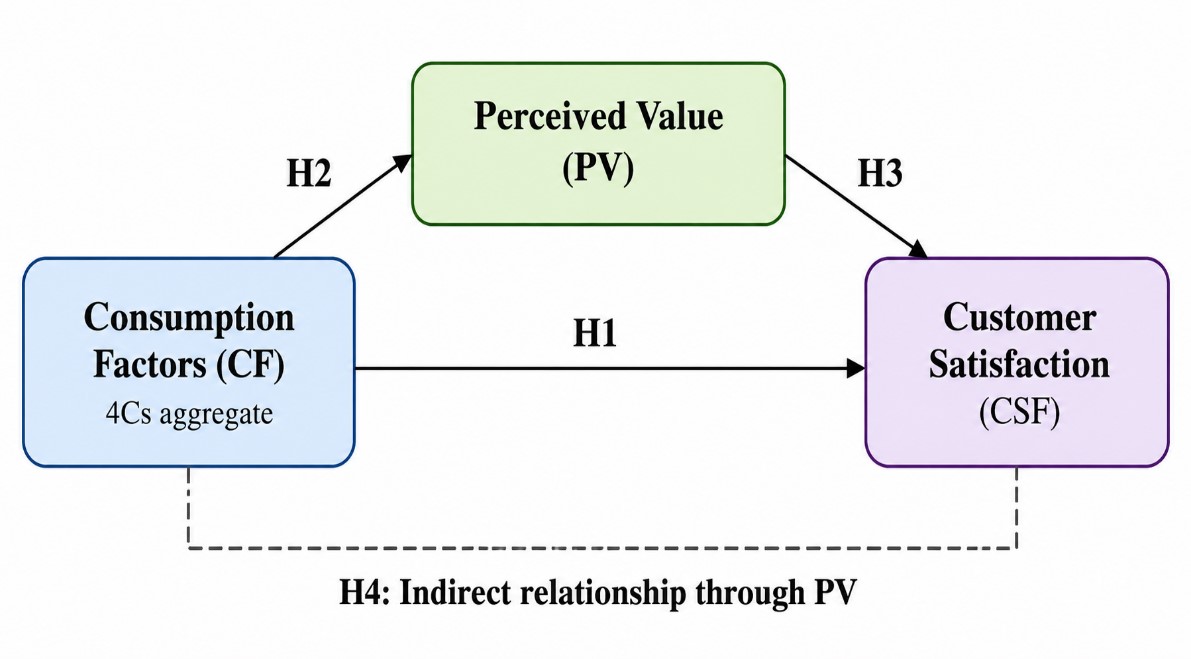
The rapid expansion of the digital economy has increased the importance of customer-centric marketing strategies for improving customer satisfaction and organizational competitiveness. However, limited empirical research has examined the mediating role of perceived value within the 4Cs Marketing Theory, particularly among China's Specialized and New Small and Medium-sized Enterprises (SMEs). This study investigates the relationships among consumption factors, perceived value, and customer satisfaction. A quantitative cross-sectional survey was conducted among 384 enterprise customers of 38 Specialized and New SMEs in the information technology sector in Shandong Province, China. Data were analyzed using confirmatory factor analysis (CFA), structural equation modeling (SEM), and bootstrap mediation analysis in AMOS. The findings revealed significant positive relationships between consumption factors and customer satisfaction (β = 0.292), consumption factors and perceived value (β = 0.478), and perceived value and customer satisfaction (β = 0.389). The estimated indirect effect suggested partial mediation, with perceived value accounting for approximately 39% of the total standardized effect. The study extends the application of the 4Cs Marketing Theory to specialized SMEs and highlights the importance of perceived value in understanding customer satisfaction. The findings provide practical guidance for strengthening customer-oriented marketing strategies, improving value creation, and enhancing customer relationships in competitive digital business environments.
References
Al-Adwan, A. S., & Yaseen, H. (2023). Solving the product uncertainty hurdle in social commerce: The mediating role of seller uncertainty. International Journal of Information Management Data Insights, 3(1), 100169. https://doi.org/10.1016/j.jjimei.2023.100169
Alhakimi, W., & Mahmoud, M. (2020). The impact of market orientation on innovativeness: evidence from Yemeni SMEs. Asia Pacific Journal of Innovation and Entrepreneurship, 14(1), 47-59. https://doi.org/10.1108/APJIE-08-2019-0060
Ali, M., & Ilyas, M. (2016). Impact of consumer centric marketing mix elements on consumer buying behavior; an empirical investigation in context of fmcg industry of Pakistan. Arabian Journal of Business and Management Review (AJBMR), 5(5), 30-42. https://doi.org/10.65453/ajbmr.v5i5.890
Alkufahy, A. M., Al-Alshare, F., Qawasmeh, F. M., Aljawarneh, N. M., & Almaslmani, R. (2023). The mediating role of the perceived value on the relationships between customer satisfaction, customer loyalty and e-marketing. International Journal of Data & Network Science, 7(2), 891-900. https://doi.org/10.5267/j.ijdns.2022.12.022
Alnoor, A., Tiberius, V., Atiyah, A. G., Khaw, K. W., Yin, T. S., Chew, X., & Abbas, S. (2024). How positive and negative electronic word of mouth (eWOM) affects customers’ intention to use social commerce? A dual-stage multi group-SEM and ANN analysis. International Journal of Human–Computer Interaction, 40(3), 808-837. https://doi.org/10.1080/10447318.2022.2125610
Ayinaddis, S. G., Taye, B. A., & Yirsaw, B. G. (2023). Examining the effect of electronic banking service quality on customer satisfaction and loyalty: an implication for technological innovation. Journal of Innovation and Entrepreneurship, 12(1), 22. https://doi.org/10.1186/s13731-023-00287-y
Blut, M., Chaney, D., Lunardo, R., Mencarelli, R., & Grewal, D. (2024). Customer perceived value: a comprehensive meta-analysis. Journal of service Research, 27(4), 501-524. https://doi.org/10.1177/10946705231222295
Chatterjee, R., & Suy, R. (2019). An overview of citizen satisfaction with public service: Based on the model of expectancy disconfirmation. Open Journal of Social Sciences, 7(4), 243-258. https://doi.org/10.4236/jss.2019.74019
Chen, L. L., Basit, A., & Hassan, Z. (2017). The impact of customer perceived value on customer satisfaction: A study on Malaysian automobile industry. International Journal of Accounting & Business Management, 5(1), 93-110. https://doi.org/10.5281/zenodo.14599693.
Chen, W., Dong, B., Hsieh, C.-W., Lee, M. J., Liu, N., Walker, R. M., Wang, Y., Wen, B., Wen, W., Wu, P., Wu, X., & Zhang, J. (2022). A replication of an experimental test of the expectancy-disconfirmation theory of citizen satisfaction. Public Administration, 100(3), 778–791. https://doi.org/10.1111/padm.12860
Chong, M. H., Chow, W. Y., Chow, X. Q., & Lim, C. C. H. (2023). Consumer satisfaction in e-shopping: Shopee Malaysia case. Asia Pacific Journal of Management and Education (APJME), 6(1), 94-107. https://doi.org/10.32535/apjme.v6i1.2231
Durak, E., Durak, Ö., Özkayagil, S., Kuşçu, S., & Gül, Z. (2023). The role of new media technologies in improving communication skills of individuals with intellectual disabilities. Journal of Education and New Approaches, 6(2), 350–366. https://doi.org/10.52974/jena.1314719
Elkhani, N., & Bakri, A. (2012). Review on “expectancy disconfirmation theory” (EDT) Model in B2C E-Commerce. Journal of information systems research and innovation (JISRI), 2(12), 95-102. http://seminar.utmspace.edu.my/jisri/
García-Fernández, J., Gálvez-Ruíz, P., Fernández-Gavira, J., Vélez-Colón, L., Pitts, B., & Bernal-García, A. (2018). The effects of service convenience and perceived quality on perceived value, satisfaction and loyalty in low-cost fitness centers. Sport Management Review, 21(3), 250-262. https://doi.org/10.1016/j.smr.2017.07.003
Ghorbani, A., Mousazadeh, H., Akbarzadeh Almani, F., Lajevardi, M., Hamidizadeh, M. R., Orouei, M., Zhu, K., & Dávid, L. D. (2023). Reconceptualizing customer perceived value in hotel management in turbulent times: A case study of Isfahan metropolis five-star hotels during the COVID-19 pandemic. Sustainability, 15(8), 7022. https://doi.org/10.3390/su15087022.
Gumussoy, C. A., & Koseoglu, B. (2016). The effects of service quality, perceived value and price fairness on hotel customers’ satisfaction and loyalty. Journal of Economics, Business and Management, 4(9), 523-527. https://doi.org/10.18178/joebm.2016.4.9.446.
Hu, Y. (2023). The influence of platform e-commerce UGC mode on the consumption willingness of generation Z: Taking Xiaohongshu as an example. Journal of Innovation and Development, 4(1), 12-18. https://doi.org/10.54097/jid.v4i1.10675.
Iqbal, A., Hasan, M. A., Bukhari, S. F., & Ramish, M. S. (2023). Determinants of customer satisfaction: The moderating role of switching cost towards customer loyalty in B2B packaged food retail setting. Journal of Education and Social Studies, 4(1), 1-15. https://doi.org/10.52223/jess.20234101.
Jo, H., & Park, D. H. (2023). Mechanisms for successful management of enterprise resource planning from user information processing and system quality perspective. Scientific Reports, 13(1), 12678. https://doi.org/10.1038/s41598-023-39787-y
Josimovski, S., Ivanovska, L. P., & Dodevski, D. (2023). Advantages of implementing artificial intelligence in e-business for consumers. KNOWLEDGE-International Journal, 60(1), 69-75. https://doi.org/10.35120/kij6001069j
Juliana, J., Aditi, B., Nagoya, R., Wisnalmawati, W., & Nurcholifah, I. (2022). Tourist visiting interests: The role of social media marketing and perceived value. International Journal of Data and Network Science, 6(2), 469–476. https://doi.org/10.5267/j.ijdns.2021.12.007.
Kadhim, K. G., Harun, A., Hamawandy, N. M., Rahman, S. K., Jamil, D. A., & Bewani, H. A. W. (2021). Factors influencing (Reputation, Perceived Value, Location, Convenience, Internal Environment, and Staff) on Customer Loyalty through Satisfaction: Perspective from Malaysia Hypermarket Industry. The Journal of Contemporary Issues in Business and Government, 27(2), 5243–5263. https://www.cibgp.com/index.php/1323-6903/article/view/1428.
Kim, B., & Cho, Y. C. (2016). Investigating the impact of justice dimension and perceived value on customer satisfaction for sharing economy of accommodation. Journal of Business & Economics Research, 14(4), 153-170. https://doi.org/10.19030/jber.v14i4.9804
Lauterborn, B. (1990). New marketing litany: Four Ps passe; C-words take over. Advertising Age, 61(41), 26.
Li, F., Larimo, J., & Leonidou, L. C. (2023). Social media in marketing research: Theoretical bases, methodological aspects, and thematic focus. Psychology & Marketing, 40(1), 124-145. https://doi.org/10.1002/mar.21746
Lubis, R. (2023). Digital marketing strategy and utilization of SWOT analysis to increase agatis brand sales as a brand-new stationery. Enrichment: Journal of Management, 12(6), 5224-5229. https://doi.org/10.35335/enrichment.v12i6.1189
Negassa, G. J., & Japee, G. P. (2023). The effect of bonding, responsiveness and communication on customer retention: the mediating role of customer satisfaction. Journal of relationship marketing, 22(2), 115-131. https://doi.org/10.1080/15332667.2023.2191111
Nofrizal, N., Juju, U., Sucherly, Arizal, N., & Waldelmi, I. (2023). Changes and determinants of consumer shopping behavior in E-commerce and social media product Muslimah. Journal of Retailing and Consumer Services, 70(4), 103146. https://doi.org/10.1016/j.jretconser.2022.103146
Pham, Q. T., Tran, X. P., Misra, S., Maskeliūnas, R., & Damaševičius, R. (2018). Relationship between convenience, perceived value, and repurchase intention in online shopping in Vietnam. Sustainability, 10(1), 156. https://doi.org/10.3390/su10010156
Pizam, A., & Milman, A. (1993). Predicting satisfaction among first time visitors to a destination by using the expectancy disconfirmation theory. International Journal of Hospitality Management, 12(2), 197-209. https://doi.org/10.1016/0278-4319(93)90010-7
Purnomo, Y. J. (2023). Digital marketing strategy to increase sales conversion on e-commerce platforms. Journal of Contemporary Administration and Management (ADMAN), 1(2), 54-62. https://doi.org/10.61100/adman.v1i2.23
Qian, Y., Sui, Z., & Wang, D. (2023). The implementation of digital marketing in brand promotion. Journal of Education, Humanities and Social Sciences, 16, 135-140. https://doi.org/10.54097/ehss.v16i.9583
Rahman, F., Mukhlis, I., Murwani, F. D., & Said, A. A. (2023). Analysis of micro small enterprises (MSEs) customer satisfaction in a global context study on Shoraya Batik Indonesia. International Journal of Scientific Multidisciplinary Research, 1(3), 167–180. https://doi.org/10.55927/ijsmr.v1i3.3910.
Sweeney, J. C., & Soutar, G. N. (2001). Consumer perceived value: The development of a multiple item scale. Journal of retailing, 77(2), 203-220. https://doi.org/10.1016/S0022-4359(01)00041-0
Tamara, C. A. J., Tumbuan, W. J. F. A., & Gunawan, E. M. (2023). Chatbots in e-commerce: a study of Gen Z customer experience and engagement–friend or foe. Jurnal EMBA: Jurnal Riset Ekonomi, Manajemen, Bisnis dan Akuntansi, 11(3), 161-175. https://doi.org/10.35794/emba.v11i3.49501
Wang, Y. (2020). Research on the effect of 4C+ 2S to customer perceived value in scene marketing of clothing industry in China. Open Journal of Business and Management, 8(2), 628-638. https://doi.org/10.4236/ojbm.2020.82037
Wu, Y. L., & Li, E. Y. (2018). Marketing mix, customer value, and customer loyalty in social commerce: A stimulus-organism-response perspective. Internet Research, 28(1), 74-104. https://doi.org/10.1108/IntR-08-2016-0250
Xu, C. (2023). Marketing Plan of T Building Materials Equipment Company (Master's thesis, ISCTE-Instituto Universitario de Lisboa (Portugal)). http://hdl.handle.net/10071/29629
Xu, K., Mohd Ariffin, S. Z., Jamaluddin, N. S., & Li, N. (2026). A Systematic Review and Thematic Synthesis of the 4Cs Marketing Framework, Perceived Value, and Customer Satisfaction. Journal of Advances in Humanities Research, 5(2), 36–50. https://doi.org/10.56868/jadhur.v5i2.350.
Yidana, Y., Yiran, W., Yuting, Z., & Jingxiang, H. (2023). Research on the Development Path of Specialized New Enterprises. The Frontiers of Society, Science and Technology, 5(8). https://dx.doi.org/10.25236/FSST.2023.050804.
Downloads
Published
Issue
Section
License
Copyright (c) 2026 Kun Xu, Siti Zubaidah Mohd Ariffin, Nor Sa'adah Jamaluddin, Na Li

This work is licensed under a Creative Commons Attribution 4.0 International License.