Organizational and Project-Management Factors in Capital-Project Delivery Performance: A Conceptual Framework
DOI:
https://doi.org/10.56868/ijmt.v4i2.118Keywords:
Capital-Project Delivery, Project Delivery Performance, Project Governance, Digital Project Management Capability, Organizational Decision-Making EffectivenessAbstract
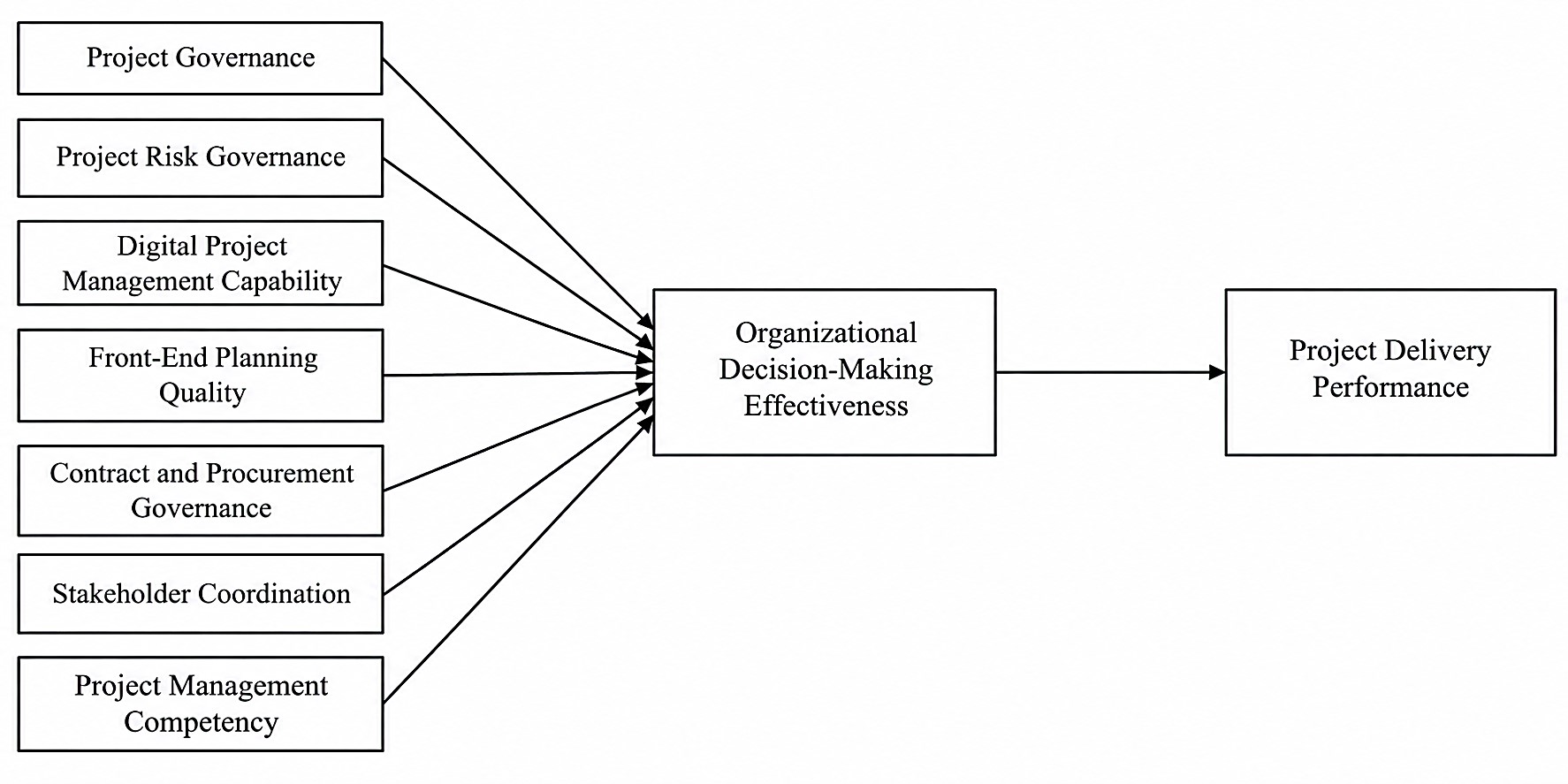
Capital-intensive projects often face cost overruns, schedule delays, and coordination problems because of complex organizations and interdependent tasks. While research examines individual factors that affect project outcomes, we still need a clearer understanding of how governance, organizational capabilities, and stakeholder relationships shape delivery performance. This paper adopts a theory-informed conceptual approach to develop an integrated framework linking seven organizational and project-management factors to Project Delivery Performance (PDP): Project Governance, Project Risk Governance, Digital Project Management Capability, Front-End Planning Quality, Contract and Procurement Governance, Stakeholder Coordination, and Project Management Competency. Drawing on Institutional Theory, Dynamic Capability Theory, Stakeholder Theory, and Contingency Theory, the framework proposes Organizational Decision-Making Effectiveness (ODME) as a potential mediating mechanism. ODME is conceptualized through decision quality, timeliness, implementation, and cross-functional alignment, while PDP encompasses schedule, cost, quality, scope fulfilment, and stakeholder satisfaction. The framework specifies direct relationships between the seven factors and PDP alongside potential indirect relationships through ODME. Project complexity, institutional environments, contractual arrangements, and organizational maturity establish contextual boundaries for interpreting these propositions. The paper contributes a conceptual explanation of how organizational conditions may translate into delivery outcomes through effective decision-making. It also clarifies construct boundaries and develops research propositions to guide future investigation. The proposed relationships remain theoretical and require empirical validation.
References
Aaltonen, K., & Kujala, J. (2010). A project lifecycle perspective on stakeholder influence strategies in global projects. Scandinavian Journal of Management, 26(4), 381–397. https://doi.org/10.1016/j.scaman.2010.09.001
Aaltonen, K., & Turkulainen, V. (2022). Institutionalization of a collaborative governance model to deliver large, inter-organizational projects. International Journal of Operations & Production Management, 42(8), 1294–1328. https://doi.org/10.1108/IJOPM-11-2021-0741
Abdulla, H. (2026). Enhancing sustainable project success: criteria considered by oil and gas project managers for efficient and effective project delivery. Management & Sustainability: An Arab Review, 5(1), 22–44. https://doi.org/10.1108/MSAR-04-2024-0019.
Al-Bdairi, M. M., Al Said Naji, J. M., & Abed, H. K. (2025). Recent Trends and Challenges in Project Management of Oil and Gas Projects: A Systematic Review. Iraqi Journal of Oil and Gas Research (IJOGR), 5(2), 51-58. https://doi.org/10.55699/ijogr.2025.0502.1089
Awolusi, I., Okonkwo, C., Lahanmi, A., & Momoh, A. (2022). Front-end planning for pipeline construction projects. American Society of Civil Engineers. In Pipelines, 76–84. https://doi.org/10.1061/9780784484272.010
Badiru, A. B., & Osisanya, S. O. (2016). Project management for the oil and gas industry: A world system approach. CRC Press.
Bahadorestani, A., Karlsen, J. T., & Farimani, N. M. (2020). Novel approach to satisfying stakeholders in megaprojects: Balancing mutual values. Journal of Management in Engineering, 36(2), 04019047. https://doi.org/10.1061/(ASCE)ME.1943-5479.0000734
Brunet, M. (2019). Governance-as-practice for major public infrastructure projects: A case of multilevel project governing. International Journal of Project Management, 37(2), 283–297. https://doi.org/10.1016/j.ijproman.2018.02.007
Caldas, C. H., & Gupta, A. (2017). Critical factors impacting the performance of mega-projects. Engineering, Construction and Architectural Management, 24(6), 920–934. https://doi.org/10.1108/ECAM-05-2016-0117
Corazza, L., Cottafava, D., Torchia, D., & Dhir, A. (2024). Interpreting stakeholder ecosystems through relational stakeholder theory: The case of a highly contested megaproject. Business Strategy and the Environment, 33(3), 2384–2412. https://doi.org/10.1002/bse.3601
Dean, J. W., & Sharfman, M. P. (1996). Does decision process matter? A study of strategic decision-making effectiveness. Academy of Management Journal, 39(2), 368–396. https://doi.org/10.5465/256784
Dehghan, R., Sepehri, M., & Fathalizadeh, A. (2022). Quantitative risk-analysis process of oil and gas upstream service contracts. Practice Periodical on Structural Design and Construction, 27(2). https://doi.org/10.1061/(ASCE)SC.1943-5576.0000680
Denicol, J., & Davies, A. (2022). The megaproject-based firm: Building programme management capability to deliver megaprojects. International Journal of Project Management, 40(5), 505–516. https://doi.org/10.1016/j.ijproman.2022.06.002
Denicol, J., Davies, A., & Krystallis, I. (2020). What Are the Causes and Cures of Poor Megaproject Performance? A Systematic Literature Review and Research Agenda. Project Management Journal, 51(3), 328-345. https://doi.org/10.1177/8756972819896113
Derakhshan, R., Turner, R., & Mancini, M. (2019). Project governance and stakeholders: A literature review. International Journal of Project Management, 37(1), 98–116. https://doi.org/10.1016/j.ijproman.2018.10.007
DiMaggio, P. J., & Powell, W. W. (1983). The iron cage revisited: Institutional isomorphism and collective rationality in organizational fields. American Sociological Review, 48(2), 147–160. https://doi.org/10.2307/2095101
Donaldson, T., & Preston, L. E. (1995). The stakeholder theory of the corporation: Concepts, evidence, and implications. Academy of Management Review, 20(1), 65–91. https://doi.org/10.5465/amr.1995.9503271992
Dooley, R. S., Fryxell, G. E., & Judge, W. Q. (2000). Belaboring the Not-So-Obvious: Consensus, Commitment, and Strategy Implementation Speed and Success. Journal of Management, 26(6), 1237-1257. https://doi.org/10.1177/014920630002600609
Edkins, A., Geraldi, J., Morris, P., & Smith, A. (2013). Exploring the front-end of project management. Engineering Project Organization Journal, 3(2), 71–85. https://doi.org/10.1080/21573727.2013.775942
Elbanna, S., & Child, J. (2007). Influences on strategic decision effectiveness: Development and test of an integrative model. Strategic Management Journal, 28(4), 431–453. https://doi.org/10.1002/smj.597
El-Reedy, M. A. (2016). Project management for the oil and gas industry. John Wiley & Sons. https://doi.org/10.1002/9781119084129
Eriksson, P. E., & Westerberg, M. (2011). Effects of cooperative procurement procedures on construction project performance: A conceptual framework. International Journal of Project Management, 29(2), 197–208. https://doi.org/10.1016/j.ijproman.2010.01.003
Erol, H., Dikmen, I., Atasoy, G., & Birgonul, M. T. (2020). Exploring the relationship between complexity and risk in megaconstruction projects. Journal of Construction Engineering and Management, 146(12), 04020138. https://doi.org/10.1061/(ASCE)CO.1943-7862.0001946
Franz, B., Molenaar, K. R., & Roberts, B. A. M. (2020). Revisiting project delivery system performance from 1998 to 2018. Journal of Construction Engineering and Management, 146(9), 04020100. https://doi.org/10.1061/(ASCE)CO.1943-7862.0001896
Freeman, R. E., Harrison, J. S., & Zyglidopoulos, S. (2018). Stakeholder theory. Cambridge University Press. https://doi.org/10.1017/9781108539500
Fu, Y., Leiringer, R., & Gottlieb, S. C. (2024). Navigating institutional demands: Organizational responses to institutional complexity in megaproject delivery. International Journal of Project Management, 42(4), 102602. https://doi.org/10.1016/j.ijproman.2024.102602
Gil, N., & Fu, Y. (2022). Megaproject performance, value creation, and value distribution: An organizational governance perspective. Academy of Management Discoveries, 8(2), 224–251. https://doi.org/10.5465/amd.2020.0029
Greiman, V. A. (2013). Megaproject management: Lessons on risk and project management from the Big Dig. John Wiley & Sons.
Hansen, S., Too, E., & Le, T. (2018). Retrospective look on front-end planning in the construction industry: A literature review of 30 years of research. International Journal of Construction Supply Chain Management, 8(1), 19–42. https://doi.org/10.14424/ijcscm801018-19-42
Haq, S. U., Liang, C., Gu, D., Du, J. T., & Zhao, S. (2018). Project governance, project performance, and the mediating role of project quality and project management risk: An agency theory perspective. Engineering Management Journal, 30(4), 274–292. https://doi.org/10.1080/10429247.2018.1503038
Jaskula, K., Kifokeris, D., Papadonikolaki, E., & Rovas, D. (2024). Common data environments in construction: State-of-the-art and challenges for practical implementation. Construction Innovation: Information Process Management, 25(5), 1522–1541. https://doi.org/10.1108/CI-04-2023-0088
Joslin, R., & Müller, R. (2016). The relationship between project governance and project success. International Journal of Project Management, 34(4), 613–626. https://doi.org/10.1016/j.ijproman.2016.01.008
Khadem, M. M. R. K., Piya, S., & Shamsuzzoha, A. (2018). Quantitative risk management in gas injection project: A case study from Oman oil and gas industry. Journal of Industrial Engineering International, 14(3), 637–654. https://doi.org/10.1007/s40092-017-0237-3
Koseoglu, O., Sakin, M., & Arayici, Y. (2018). Exploring the BIM and lean synergies in the Istanbul Grand Airport construction project. Engineering, Construction and Architectural Management, 25(10), 1339–1354. https://doi.org/10.1108/ECAM-08-2017-0186
Kujala, J., Aaltonen, K., Gotcheva, N., & Lahdenperä, P. (2021). Dimensions of governance in interorganizational project networks. International Journal of Managing Projects in Business, 14(3), 625–651. https://doi.org/10.1108/IJMPB-12-2019-0312
Laaksonen, O., & Peltoniemi, M. (2018). The essence of dynamic capabilities: A systematic review. International Journal of Management Reviews, 20(2), 184–205. https://doi.org/10.1111/ijmr.12122
Levitt, R. E., Thomsen, J., Christiansen, T. R., Kunz, J. C., Jin, Y., & Nass, C. (1999). Simulating project work processes and organizations: Toward a micro-contingency theory of organizational design. Management Science, 45(11), 1479–1495. https://doi.org/10.1287/mnsc.45.11.1479
Luo, L., He, Q., Xie, J., Yang, D., & Wu, G. (2017). Investigating the relationship between project complexity and success in complex construction projects. Journal of Management in Engineering, 33(2), 04016036. https://doi.org/10.1061/(ASCE)ME.1943-5479.0000471
Merrow, E. W. (2024). Industrial megaprojects: Concepts, strategies, and practices for success (2nd ed.). John Wiley & Sons.
Mok, K. Y., Shen, G. Q., & Yang, J. (2015). Stakeholder management studies in mega construction projects: A review and future directions. International journal of project management, 33(2), 446-457. 10.1016/j.ijproman.2014.08.007.
Müller, R., & Lecoeuvre, L. (2014). Operationalizing governance in project management. International Journal of Project Management, 32(8), 1346–1357. https://doi.org/10.1016/j.ijproman.2014.04.005
Musawir, A. U., Serra, C. E. M., Zwikael, O., & Ali, I. (2017). Project governance, benefit management, and project success: Towards a framework for supporting organizational strategy implementation. International Journal of Project Management, 35(8), 1658–1672. https://doi.org/10.1016/j.ijproman.2017.07.007
Nyarirangwe, M., & Babatunde, O. K. (2019). Megaproject complexity attributes and competences: Lessons from IT and construction projects. International Journal of Information Systems and Project Management, 7(4), 77–99. https://doi.org/10.12821/ijispm070404
Rolstadås, A., & Schiefloe, P. M. (2017). Modelling project complexity. International Journal of Managing Projects in Business, 10(2), 295–314. https://doi.org/10.1108/IJMPB-02-2016-0015
Sankaran, S., Drouin, N., & Locatelli, G. (2025). Special issue: Project governance: Reflections on the past and suggestions for the future. Project Management Journal, 56(1), 3–14. https://doi.org/10.1177/87569728251315013
Serrador, P., & Turner, R. (2015). The relationship between project success and project efficiency. Project Management Journal, 46(1), 30–39. https://doi.org/10.1002/pmj.21468
Shenhar, A. J., Dvir, D., Levy, O., & Maltz, A. C. (2001). Project success: A multidimensional strategic concept. Long Range Planning, 34(6), 699–725. https://doi.org/10.1016/S0024-6301(01)00097-8
Shepherd, N. G., & Rudd, J. M. (2014). The influence of context on the strategic decision‐making process: A review of the literature. International journal of management reviews, 16(3), 340-364. https://doi.org/10.1111/ijmr.12023
Sirisomboonsuk, P., Gu, V. C., Cao, R. Q., & Burns, J. R. (2018). Relationships between project governance and information technology governance and their impact on project performance. International Journal of Project Management, 36(2), 287–300. https://doi.org/10.1016/j.ijproman.2017.10.003
Suprapto, M., Bakker, H. L. M., Mooi, H. G., & Moree, W. (2015). Sorting out the essence of owner–contractor collaboration in capital project delivery. International Journal of Project Management, 33(3), 664–683. https://doi.org/10.1016/j.ijproman.2014.05.001
Takey, S. M., & Carvalho, M. M. (2015). Competency mapping in project management: An action research study. International Journal of Project Management, 33(4), 784–796. https://doi.org/10.1016/j.ijproman.2014.10.013
Teece, D. J. (2007). Explicating dynamic capabilities: The nature and microfoundations of (sustainable) enterprise performance. Strategic Management Journal, 28(13), 1319–1350. https://doi.org/10.1002/smj.640
Teller, J., & Kock, A. (2013). An empirical investigation on how portfolio risk management impacts project portfolio success. International Journal of Project Management, 31(6), 817–829. https://doi.org/10.1016/j.ijproman.2012.11.012
Tirmizi, S. A. A., & Arif, F. (2023). Identification and stakeholder responsibility mapping of contractual risk factors in oil and gas sector infrastructure projects using Delphi technique. Mehran University Research Journal of Engineering and Technology, 42(1). https://doi.org/10.22581/muet1982.2301.03
Welde, M., & Volden, G. H. (2022). Improving value for money through better front-end management: An attempt to reduce costs and increase user benefits in the planning of a motorway project. Case Studies on Transport Policy, 10(3), 1611–1619. https://doi.org/10.1016/j.cstp.2022.05.019
Whyte, J. (2019). How digital information transforms project delivery models. Project Management Journal, 50(2), 177–194. https://doi.org/10.1177/8756972818823304
Downloads
Published
Issue
Section
License
Copyright (c) 2026 Faisal Hassan Ali Alfarsi, Yu Hock Oo

This work is licensed under a Creative Commons Attribution 4.0 International License.