Evaluating Decision Criteria for Rooftop Rainwater Harvesting Retrofits in Institutional Buildings: A Critical Integrative Review
DOI:
https://doi.org/10.56868/ijmt.v4i2.120Keywords:
Rooftop Rainwater Harvesting, Building Retrofit, Multi-Criteria Decision Analysis, sustainable water management, sustainable facilities managementAbstract
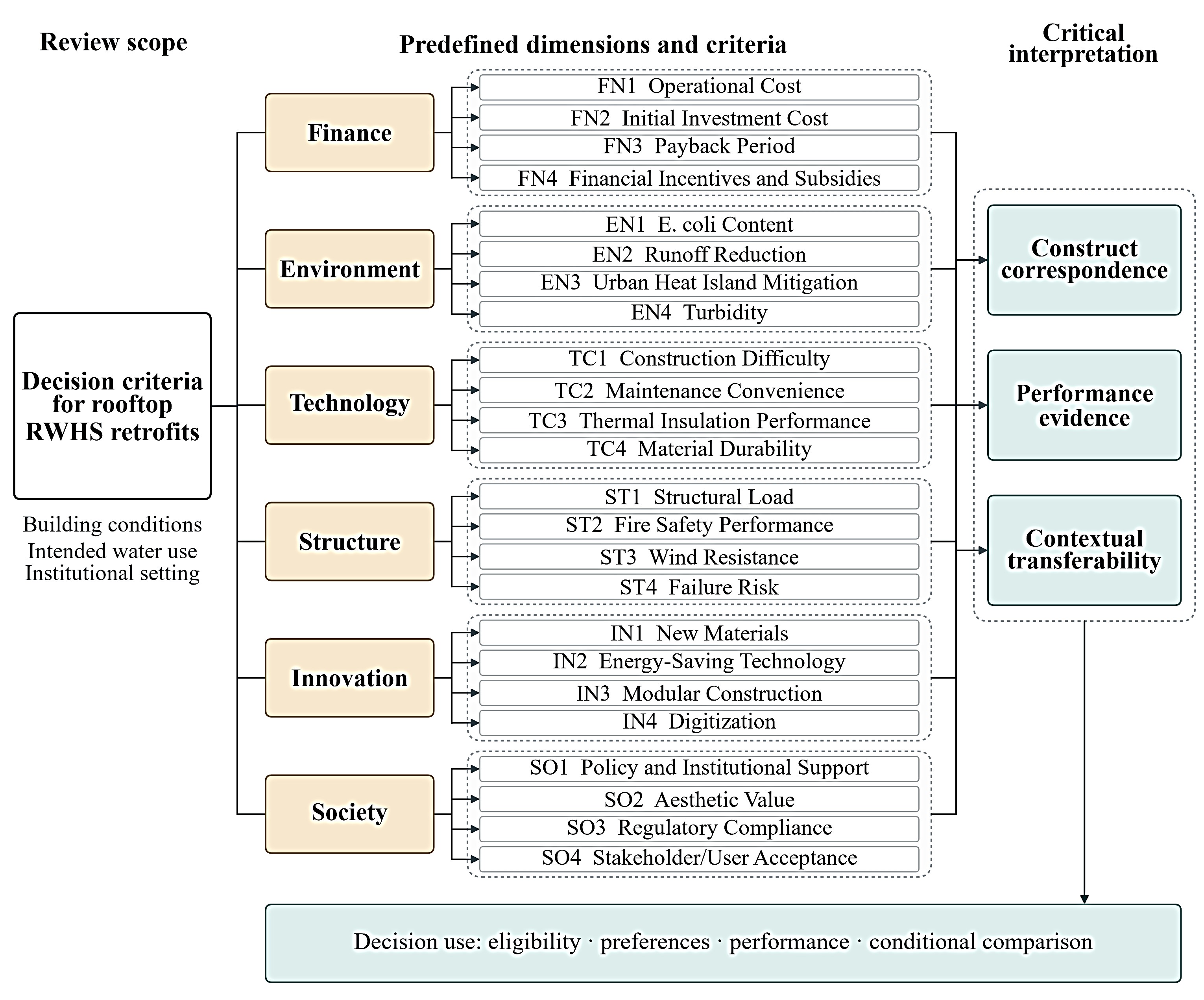
Rooftop rainwater harvesting retrofits in institutional buildings require evidence on water performance, affordability, constraints, and operations, yet inconsistent boundaries limit transferability. This critical integrative review examines the decision criteria and evidentiary requirements supporting institutional retrofit decisions. A purposive sample of 83 full-text publications, screened from 309 Web of Science records, was systematically evaluated against 24 predefined criteria spanning financial, environmental, technological, structural, innovation, and social dimensions. Following a targeted verification audit across 1,992 publication–criterion pairs, the resulting evidence matrix documented 205 direct and 402 indirect construct correspondences. Financial and maintenance-related criteria received substantially broader coverage than thermal, structural, and innovation criteria. Direct correspondence spanned diverse forms of support from conceptual inclusion and design assumptions to modelled and measured outcomes. Financial recovery depended heavily on expenditure boundaries and tariff assumptions, while long-term runoff retention and event-scale discharge control represented non-interchangeable hydrological outcomes. A proposed decision architecture separates building context and mandatory eligibility screening from stakeholder preferences and alternative-specific performance, establishing baseline information requirements prior to retrofit comparison. By distinguishing evidentiary depth and exposing overlapping measures, the review establishes a transparent foundation for criterion selection. Although purposive sampling, single-researcher appraisal, and heterogeneous evidence limit generalizability, the prospective framework offers a rigorous basis for future building-specific validation.
References
Abdelkader, M. M., Mahmoud, U. F., Mobasher, A. M., & Reda, M. A. (2023). Multi-criteria decision support system for selecting the rainwater harvesting technique in wadi systems, Sinai, Egypt. Water Practice & Technology, 18(3), 701–715. https://doi.org/10.2166/wpt.2023.031
Abebe, H. M., & Kassa, A. K. (2025). Hydrological suitability analysis for rainwater harvesting using GIS-based fuzzy AHP: Mojo watershed, Ethiopia. Water Practice & Technology, 20(9), 1868–1890. https://doi.org/10.2166/wpt.2025.098
Adham, A., Riksen, M., Ouessar, M., & Ritsema, C. J. (2016a). A methodology to assess and evaluate rainwater harvesting techniques in (semi-) arid regions. Water, 8(5), 198. https://doi.org/10.3390/w8050198
Adham, A., Riksen, M., Ouessar, M., & Ritsema, C. (2016b). Identification of suitable sites for rainwater harvesting structures in arid and semi-arid regions: A review. International Soil and Water Conservation Research, 4(2), 108-120. https://doi.org/10.1016/j.iswcr.2016.03.001
Ahmad, R., Gabriel, H. F., Alam, F., Zarin, R., Raziq, A., Nouman, M., ... & Liou, Y. A. (2024). Remote sensing and GIS based multi-criteria analysis approach with application of AHP and FAHP for structures suitability of rainwater harvesting structures in Lai Nullah, Rawalpindi, Pakistan. Urban Climate, 53, 101817. https://doi.org/10.1016/j.uclim.2024.101817
Ahmed, S., Jesson, M., & Sharifi, S. (2023). Selection frameworks for potential rainwater harvesting sites in arid and semi-arid regions: A systematic literature review. Water, 15(15), 2782. https://doi.org/10.3390/w15152782
Akter, A., & Ahmed, S. (2015). Potentiality of rainwater harvesting for an urban community in Bangladesh. Journal of Hydrology, 528, 84–93. https://doi.org/10.1016/j.jhydrol.2015.06.017
Akter, A., & Ahmed, S. (2021). Rainwater harvesting potentials for a water-scarce city in Bangladesh. Proceedings of the Institution of Civil Engineers - Water Management, 174(2), 84–98. https://doi.org/10.1680/jwama.19.00030
Bai, Y., Zhang, W., Yang, X., Wei, S., & Yu, Y. (2021). The framework of technical evaluation indicators for constructing low-carbon communities in China. Buildings, 11(10), 479. https://doi.org/10.3390/buildings11100479
Behzadian, K., & Kapelan, Z. (2015). Advantages of integrated and sustainability based assessment for metabolism based strategic planning of urban water systems. Science of the Total Environment, 527–528, 220–231. https://doi.org/10.1016/j.scitotenv.2015.04.097
Bianco, F., Mennini, A., Merlin, M., Fantasia, N., & Race, M. (2026). Reliability-oriented Digital Twin of a building-scale rainwater treatment and reuse system under uncertain demand and climate variability. Reliability Engineering & System Safety, 277, 113206. https://doi.org/10.1016/j.ress.2026.113206
Bouramdane, A.-A. (2023). Optimal water management strategies: Paving the way for sustainability in smart cities. Smart Cities, 6(5), 2849–2882. https://doi.org/10.3390/smartcities6050128
Bouziotas, D., van Duuren, D., van Alphen, H. J., Frijns, J., Nikolopoulos, D., & Makropoulos, C. (2019). Towards circular water neighborhoods: Simulation-based decision support for integrated decentralized urban water systems. Water, 11(6), 1227. https://doi.org/10.3390/w11061227
Buckley, J. J. (1985). Fuzzy hierarchical analysis. Fuzzy Sets and Systems, 17(3), 233–247. https://doi.org/10.1016/0165-0114(85)90090-9
Chadee, A. A., Ali, B., Mallikarjuna, V., Jameel, M., & Azamathulla, H. M. (2024). Application of the analytic hierarchy process for the selection of recycling rainwater/household grey water to improve SIDS sustainability targets. Modeling Earth Systems and Environment, 10(2), 1883–1895. https://doi.org/10.1007/s40808-023-01875-3
Chen, S., Sun, H., & Chen, X. (2025). Towards a new era of rainwater utilization: Implementation status, barriers, and prospects of decentralized rainwater harvesting systems in China. Environmental Reviews, 33, 1–21. https://doi.org/10.1139/er-2024-0114
Chhipi-Shrestha, G., Hewage, K., & Sadiq, R. (2018). Economic and energy efficiency of net-zero water communities: System dynamics analysis. Journal of Sustainable Water in the Built Environment, 4(3), 04018006. https://doi.org/10.1061/JSWBAY.0000854
Chi, Y., Bai, G., & Dong, H. (2021). A new multicriteria decision-making method for the selection of sponge city schemes with Shapley–Choquet aggregation operators. Mathematical Problems in Engineering, 2021, 6615709. https://doi.org/10.1155/2021/6615709
Chiu, Y. R., Aghaloo, K., & Mohammadi, B. (2020). Incorporating rainwater harvesting systems in Iran’s potable water-saving scheme by using a GIS-simulation based decision support system. Water, 12(3), 752. https://doi.org/10.3390/w12030752
Demir, S., Dilman Gokkaya, M., & Ersoz, N. D. (2025). Prioritization blue-green infrastructure strategies: Developing a hybrid quantitative approach model for sustainable urban water management. Water Resources Management, 39(8), 3901–3919. https://doi.org/10.1007/s11269-025-04136-3
Dias, D. F., Abily, M., Ribeiro, J. M., Jouhara, H., & Katsou, E. (2024). Screening rainwater harvesting potentialities in the EU industrial sector: A framework for site-specific assessment. Water, 16(12), 1758. https://doi.org/10.3390/w16121758
Díaz-Vázquez, D., Camacho-Sandoval, T., Reynoso-Delgadillo, J., Gómez-Ayo, N. A., Macías-Calleja, M. G., Martínez-Barba, M. P., & Gradilla-Hernandez, M. S. (2023). Characterization and multicriteria prioritization of water scarcity in sensitive urban areas for the implementation of a rain harvesting program: A case study for water-scarcity mitigation. Urban Climate, 51, 101670. https://doi.org/10.1016/j.uclim.2023.101670
Domènech, L., March, H., & Saurí, D. (2013). Degrowth initiatives in the urban water sector? A social multi-criteria evaluation of non-conventional water alternatives in Metropolitan Barcelona. Journal of Cleaner Production, 38, 44–55. https://doi.org/10.1016/j.jclepro.2011.09.020
dos Santos Amorim, J. M. B., Bezerra, S. D. T. M., Silva, M. M., & de Sousa, L. C. O. (2020). Multicriteria decision support for selection of alternatives directed to integrated urban water management. Water Resources Management, 34(13), 4253–4269. https://doi.org/10.1007/s11269-020-02671-9
Duong, T. T. H., Adin, A., Jackman, D., van der Steen, P., & Vairavamoorthy, K. (2011). Urban water management strategies based on a total urban water cycle model and energy aspects – Case study for Tel Aviv. Urban Water Journal, 8(2), 103–118. https://doi.org/10.1080/1573062x.2010.546861
Edirisinghe, R. D., & Pathirana, S. (2021). Reduction potential of potable water consumption at urban households: A case study in Sri Lanka. Environment, Development and Sustainability, 23(9), 13689–13706. https://doi.org/10.1007/s10668-021-01234-1
Fariz-Salinas, E. A., Acuña-Bedoya, J. D., Rodríguez, R. I. F., Turrén-Cruz, T., & Zavala, M. Á. L. (2025). Definition of potential sites to implement urban rainwater harvesting systems in water-stressed cities by integrating GIS and AHP tools. Urban Climate, 64, 102639. https://doi.org/10.1016/j.uclim.2025.102639
Farooq, S., Mahmood, K., & Faizi, F. (2022). Comparative simulation of GIS-based rainwater management solutions. Water Resources Management, 36(9), 3049–3065. https://doi.org/10.1007/s11269-022-03185-2
Farooqui, T. A., Renouf, M. A., & Kenway, S. J. (2016). A metabolism perspective on alternative urban water servicing options using water mass balance. Water Research, 106, 415–428. https://doi.org/10.1016/j.watres.2016.10.014
Fonseca, C. R., Hidalgo, V., Díaz-Delgado, C., Vilchis-Francés, A. Y., & Gallego, I. (2017). Design of optimal tank size for rainwater harvesting systems through use of a web application and geo-referenced rainfall patterns. Journal of Cleaner Production, 145, 323–335. https://doi.org/10.1016/j.jclepro.2017.01.057
Galarza-Molina, S. L., Torres, A., Moura, P., & Lara-Borrero, J. (2015). CRIDE: A case study in multi-criteria analysis for decision-making support in rainwater harvesting. International Journal of Information Technology & Decision Making, 14(01), 43–67. https://doi.org/10.1142/S0219622014500862
Haider, H., Ghumman, A. R., Al-Salamah, I. S., Ghazaw, Y., & Abdel-Maguid, R. H. (2019). Sustainability evaluation of rainwater harvesting-based flood risk management strategies: A multilevel decision-making framework for arid environments. Arabian Journal for Science and Engineering, 44(10), 8465–8488. https://doi.org/10.1007/s13369-019-03848-0
Hämmerling, M., Kocięcka, J., & Liberacki, D. (2020). Analysis of the possibilities of rainwater harvesting based on the AHP method. Rocznik Ochrona Środowiska, 22(1), 294–307. https://www.ros.edu.pl/journal/contents/articles/2020-vol-22-no-1/023-ros-v22-r2020
Hamidi, M. N., Shitreh, S., Cengiz, A. I., Ozcelik, K., Eryildiz-Yesir, B., Ekmekcioğlu, Ö., Halat, O. M., Demirel, M. C., Canberk, B., Koyuncu, I., Isik, O., Guven, H., Ozgun, H., & Ersahin, M. E. (2025). Efficient roof selection in rainwater harvesting: Hybrid multi-criteria and experimental approach. Water Resources Management, 39(4), 1567–1586. https://doi.org/10.1007/s11269-024-04023-3
Han, F., Alkhawaji, R. N., & Shafieezadeh, M. M. (2025). Evaluating sustainable water management strategies using TOPSIS and fuzzy TOPSIS methods. Applied Water Science, 15(1), 4. https://doi.org/10.1007/s13201-024-02336-7
Hargreaves, A. J., Farmani, R., Ward, S., & Butler, D. (2019). Modelling the future impacts of urban spatial planning on the viability of alternative water supply. Water Research, 162, 200–213. https://doi.org/10.1016/j.watres.2019.06.029
Hsueh, S. L., Feng, Y., Sun, Y., Jia, R., & Yan, M. R. (2021). Using AI-MCDM model to boost sustainable energy system development: A case study on solar energy and rainwater collection in Guangdong Province. Sustainability, 13(22), 12505. https://doi.org/10.3390/su132212505
Hsueh, S. L., Sun, Y., Zhang, Y., Xiao, N., & Meen, T. H. (2022). Decision-making model based on discriminant analysis fuzzy method for low-carbon and eco-friendly residence design: Case study of Conghua District, Guangzhou, China. Buildings, 12(6), 815. https://doi.org/10.3390/buildings12060815
Husain, S. H., Shahruddin, S., Norazman, N., Agus Salim, N. A., & Mustaffa, M. (2025). A systematic literature review on formulating the employability skill set for entry-level building surveyors. International Journal of Construction Management, 25(14), 1660–1674. https://doi.org/10.1080/15623599.2025.2460354.
Imteaz, M. A., Shanableh, A., Rahman, A., & Ahsan, A. (2011). Optimisation of rainwater tank design from large roofs: A case study in Melbourne, Australia. Resources, Conservation and Recycling, 55(11), 1022–1029. https://doi.org/10.1016/j.resconrec.2011.05.013
Kaposztasova, D., Vranayova, Z., Markovic, G., & Purcz, P. (2014). Rainwater harvesting, risk assessment and utilization in Kosice-city, Slovakia. Procedia Engineering, 89, 1500–1506. https://doi.org/10.1016/j.proeng.2014.11.439
Karim, M. R., Rimi, R. A., & Billah, M. S. (2015). Analysis of storage volume and reliability of the rainwater harvesting tanks in the coastal area of Bangladesh. Desalination and Water Treatment, 54(13), 3544–3550. https://doi.org/10.1080/19443994.2014.923201
Kee, K. K., Ting, H. Y., Lim, Y. S., Ting, J. T. W., Peter, M., Ibrahim, K., & Show, P. L. (2022). Feasibility of UTS Smart Home to support Sustainable Development Goals of United Nations (UN SDGs): Water and energy conservation. Sustainability, 14(19), 12242. https://doi.org/10.3390/su141912242
Kordana, S., & Słyś, D. (2020). Decision criteria for the development of stormwater management systems in Poland. Resources, 9(2), 20. https://doi.org/10.3390/resources9020020
Lepota, T., & Armitage, N. (2025). The prospects for rainwater harvesting at the University of Cape Town. Water SA, 51(2 April), 132–149. https://doi.org/10.17159/wsa/2025.v51.i2.4110
Liu, B., Huang, J. J., McBean, E., & Li, Y. (2020). Risk assessment of hybrid rain harvesting system and other small drinking water supply systems by game theory and fuzzy logic modeling. Science of the Total Environment, 708, 134436. https://doi.org/10.1016/j.scitotenv.2019.134436
Loper, S. A., Zimmerman, S. A., Stoughton, K. L., Pamintuan, B. C., & Kilgannon, E. M. (2024). Geographic information system mapping tool for rainwater harvesting in the United States. Journal of Water Resources Planning and Management, 150(5), 04024012. https://doi.org/10.1061/jwrmd5.wreng-6236
Luo, P., Wang, Z., Luo, M., Chen, J., Zhang, Y., Zhou, M., ... & Elbeltagi, A. (2026). Spatiotemporal assessment of rainwater harvesting efficiency for multi-story residential buildings across different climate zones in China. Ecological Indicators, 182, 114531. https://doi.org/10.1016/j.ecolind.2025.114531
Mahmoud, S. H., & Tang, X. (2015). Monitoring prospective sites for rainwater harvesting and stormwater management in the United Kingdom using a GIS-based decision support system. Environmental Earth Sciences, 73(12), 8621–8638. https://doi.org/10.1007/s12665-015-4026-2
Martínez-Acosta, L., López-Lambraño, A. A., & López-Ramos, A. (2019). Design criteria for planning the agricultural rainwater harvesting systems: A review. Applied Sciences, 9(24), 5298. https://doi.org/10.3390/app9245298
Mbilinyi, B. P., Tumbo, S. D., Mahoo, H. F., Senkondo, E. M., & Hatibu, N. (2005). Indigenous knowledge as decision support tool in rainwater harvesting. Physics and Chemistry of the Earth, Parts A/B/C, 30(11–16), 792–798. https://doi.org/10.1016/j.pce.2005.08.022
Melville-Shreeve, P., Ward, S., & Butler, D. (2016). Rainwater harvesting typologies for UK houses: A multi criteria analysis of system configurations. Water, 8(4), 129. https://doi.org/10.3390/w8040129
Meshram, S. G., Ilderomi, A. R., Sepehri, M., Jahanbakhshi, F., Kiani-Harchegani, M., Ghahramani, A., & Rodrigo-Comino, J. (2021). Impact of roof rain water harvesting of runoff capture and household consumption. Environmental Science and Pollution Research, 28(36), 49529–49540. https://doi.org/10.1007/s11356-021-14098-9
Mummidivarapu, S. K., Rehana, S., Sowmya, C. S., & Rahman, A. (2026). Multi-criteria geospatial assessment of rainwater harvesting potential in urban environments using remote sensing and GIS. Water, 18(9), 1014. https://doi.org/10.3390/w18091014
Ndeketeya, A., & Dundu, M. (2023). Urban rainwater harvesting adoption potential in a socio-economically diverse city using a GIS-based multi-criteria decision method. Water Resources Management, 37(2), 835–850. https://doi.org/10.1007/s11269-022-03407-7
Nnaji, C. C., & Banigo, A. (2018). Multi-criteria evaluation of sources for self-help domestic water supply. Applied Water Science, 8(1), 12. https://doi.org/10.1007/s13201-018-0657-2
Onu, U. P., Xie, Q., & Xu, L. (2017). A fuzzy TOPSIS model framework for ranking sustainable water supply alternatives. Water Resources Management, 31(9), 2579–2593. https://doi.org/10.1007/s11269-017-1636-3
Palermo, S. A., Talarico, V. C., & Pirouz, B. (2020). Optimizing rainwater harvesting systems for non-potable water uses and surface runoff mitigation. In Y. D. Sergeyev & D. E. Kvasov (Eds.), Numerical Computations: Theory and Algorithms (Vol. 11973, pp. 570–582). Springer International Publishing. https://doi.org/10.1007/978-3-030-39081-5_49
Portman, M. E., Vdov, O., Schuetze, M., Gilboa, Y., & Friedler, E. (2022). Public perceptions and perspectives on alternative sources of water for reuse generated at the household level. Water Reuse, 12(1), 157–174. https://doi.org/10.2166/wrd.2022.002
Quinn, R., Rougé, C., & Stovin, V. (2021). Quantifying the performance of dual-use rainwater harvesting systems. Water Research X, 10, 100081. https://doi.org/10.1016/j.wroa.2020.100081
Rahman, A. (2017). Recent advances in modelling and implementation of rainwater harvesting systems towards sustainable development. Water, 9(12), 959. https://doi.org/10.3390/w9120959
Rivera Vázquez, B. I., Salcedo Sánchez, E. R., Martínez, J. M. E., Gómez-Ayo, M. Á., González-Noguez, F., García-Flores, C., & Talavera-Mendoza, O. (2023). Use of analytic hierarchy process method to identify potential rainwater harvesting sites: Design and financial strategies in Taxco de Alarcón, Southern Mexico. Sustainability, 15(10), 8220. https://doi.org/10.3390/su15108220
Rozos, E., Makropoulos, C., & Butler, D. (2010). Design robustness of local water-recycling schemes. Journal of Water Resources Planning and Management, 136(5), 531–538. https://doi.org/10.1061/(ASCE)WR.1943-5452.0000067
Saaty, T. L. (2008). Decision making with the analytic hierarchy process. International Journal of Services Sciences, 1(1), 83–98. https://doi.org/10.1504/IJSSCI.2008.017590
Sikder, A. H. M. K., & Salehin, M. (2014). Participatory multi-criteria evaluation of alternative options for water supply in cyclone-prone areas of Bangladesh. Journal of Water, Sanitation and Hygiene for Development, 4(1), 100–107. https://doi.org/10.2166/washdev.2014.094
Sikder, A. H. M. K., & Salehin, M. (2015). Multi-criteria decision making methods for rural water supply: A case study from Bangladesh. Water Policy, 17(6), 1209–1223. https://doi.org/10.2166/wp.2015.111
Souza, H. H. D. S., Morandi, C. G., Boncz, M. Á., Paulo, P. L., & Steinmetz, H. (2025). Life cycle sustainability assessment of greywater treatment and rainwater harvesting for decentralized water reuse in Brazil and Germany. Resources, 14(6), 96. https://doi.org/10.3390/resources14060096
Saha, A., Setu, S., Das, S., Hossain, M. I., Rahman, A. K., & Rahman, M. M. (2024). Decision support system for community managed rainwater harvesting: A case study in the salinity-prone coastal region of Bangladesh. Heliyon, 10(9), e30455. https://doi.org/10.1016/j.heliyon.2024.e30455
Saha, D., & Bhattacharya, R. N. (2020). Potential for integrating solar rooftop photovoltaic system with rain water harvesting and electric vehicle charging facility: Designing a multicriteria framework. 2020 International Conference and Utility Exhibition on Energy, Environment and Climate Change (ICUE), 1–8. https://doi.org/10.1109/ICUE49301.2020.9307088
Sampaio, F. E. de O. V., & Alves, C. de M. A. (2017). A procedure to analyze the viability of rainwater harvesting systems in urban areas based on pre-defined diagrams. RBRH, 22(0), e60. https://doi.org/10.1590/2318-0331.0217160012
Sánchez-Sabau, S., Sabău, M., Montero, L., González-Coneo, J., Abellàn, A., & Osorio, C. (2017). A look to the sustainable draining systems: Criteria of sustainability and successful cases. International Journal of Conservation Science, 8(3), 453–464. https://ijcs.ro/public/IJCS-17-44_Sanchez-Sabau.pdf
Shadeed, S. M., Judeh, T. G., & Almasri, M. N. (2019). Developing GIS-based water poverty and rainwater harvesting suitability maps for domestic use in the Dead Sea region (West Bank, Palestine). Hydrology and Earth System Sciences, 23(3), 1581–1592. https://doi.org/10.5194/hess-23-1581-2019
Toosi, A. S., Tousi, E. G., Ghassemi, S. A., Cheshomi, A., & Alaghmand, S. (2020). A multi-criteria decision analysis approach towards efficient rainwater harvesting. Journal of Hydrology, 582, 124501. https://doi.org/10.1016/j.jhydrol.2019.124501
Shah, T. M., Egwu, C. O., Hammad, M., & Otterpohl, R. (2024). Decision support systems based on a multiple-criteria decision analysis to promote a whole-of-resource approach for water management, with a case study of rural Bengaluru in India. Water, 16(12), 1674. https://doi.org/10.3390/w16121674
Shrestha, A., Stephen, H., & Ahmad, S. (2023). Performance evaluation of rainwater harvesting structures in arid and semi-arid regions. World Environmental and Water Resources Congress 2023, 789–796. https://doi.org/10.1061/9780784484852.074
Song, S., Che, J., & Yuan, X. (2022). Disaster prevention and mitigation index assessment of green buildings based on the fuzzy analytic hierarchy process. Sustainability, 14(19), 12284. https://doi.org/10.3390/su141912284
Swilla, L. M., Katambara, Z., & Lingwanda, M. (2024). Application of multi-criteria decision-making on low-impact development practice selection for the Kinyerezi River sub-catchments in Dar es Salaam, Tanzania. Water Science & Technology, 89(9), 2396–2415. https://doi.org/10.2166/wst.2024.130
Tavakol-Davani, H., Burian, S. J., & Apul, D. (2018a). A watershed scale life cycle assessment framework for stormwater management. In S. Kamojjala (Ed.), World Environmental and Water Resources Congress 2018: Groundwater, sustainability, and hydro-climate/climate change (pp. 294–303). American Society of Civil Engineers. https://doi.org/10.1061/9780784481417.030
Tavakol-Davani, H., Burian, S. J., Butler, D., Sample, D., Devkota, J., & Apul, D. (2018b). Combining hydrologic analysis and life cycle assessment approaches to evaluate sustainability of water infrastructure. Journal of Irrigation and Drainage Engineering, 144(11), Article 05018006. https://doi.org/10.1061/(ASCE)IR.1943-4774.0001340
Van de Walle, A., Torfs, E., Gaublomme, D., & Rabaey, K. (2022). In silico assessment of household level closed water cycles: Towards extreme decentralization. Environmental Science and Ecotechnology, 10, 100148. https://doi.org/10.1016/j.ese.2022.100148
Vargas, D., Dominguez, I., Ward, S., & Oviedo-Ocaña, E. R. (2019). Assisting global rainwater harvesting practitioners: a decision support tool for tank sizing method selection under uncertainty. Environmental Science: Water Research & Technology, 5(3), 506–520. https://doi.org/10.1039/c8ew00707a
Vranayová, Z., Kaposztasova, D., Zeleňáková, M., & Markovic, G. (2015). Stormwater management in compliance with sustainable design of buildings. In P. Hlavínek & M. Zeleňáková (Eds.), Storm Water Management: Examples from Czech Republic, Slovakia and Poland (pp. 113–135). Springer International Publishing. https://doi.org/10.1007/978-3-319-25835-5_8
Willuweit, L., & O’Sullivan, J. J. (2013). A decision support tool for sustainable planning of urban water systems: Presenting the Dynamic Urban Water Simulation Model. Water Research, 47(20), 7206–7220. https://doi.org/10.1016/j.watres.2013.09.060
Wurthmann, K. (2020). Rainwater harvesting system installations required to offset new water demand created by growing populations in Broward and Palm Beach Counties: A dataset for decision making based on numbers of installations, costs, and water and energy savings. Data in Brief, 28, 105016. https://doi.org/10.1016/j.dib.2019.105016
Yousuf, A., Dervash, M. A., Sur, K., Singh, M. J., Bhat, M. A., & Sharma, N. (2026). GIS-based multi-criteria decision analysis using AHP and fuzzy-AHP for identifying potential rainwater harvesting zones in lower Shivaliks of Punjab (India). Acta Geophysica, 74(2), 101. https://doi.org/10.1007/s11600-026-01789-5
Zhan, Y., Hong, N., Yang, B., Du, Y., Wu, Q., & Liu, A. (2020). Toxicity variability of urban road stormwater during storage processes in Shenzhen, China: Identification of primary toxicity contributors and implications for reuse safety. Science of the Total Environment, 745, 140964. https://doi.org/10.1016/j.scitotenv.2020.140964
Downloads
Published
Issue
Section
License
Copyright (c) 2026 Jie Zhang, Pau Chung Leng, Ihab Hasan Hatif

This work is licensed under a Creative Commons Attribution 4.0 International License.