Assessing Contractor Site Supervision for Construction Delay Mitigation: Delay Factors, Implementation Barriers and Improvement Strategies in Kuala Lumpur, Malaysia
DOI:
https://doi.org/10.56868/ijmt.v4i2.121Keywords:
Construction delays, Contractor site supervision, Construction Project Management, Organizational Barriers, Malaysian Institute of ArchitectsAbstract
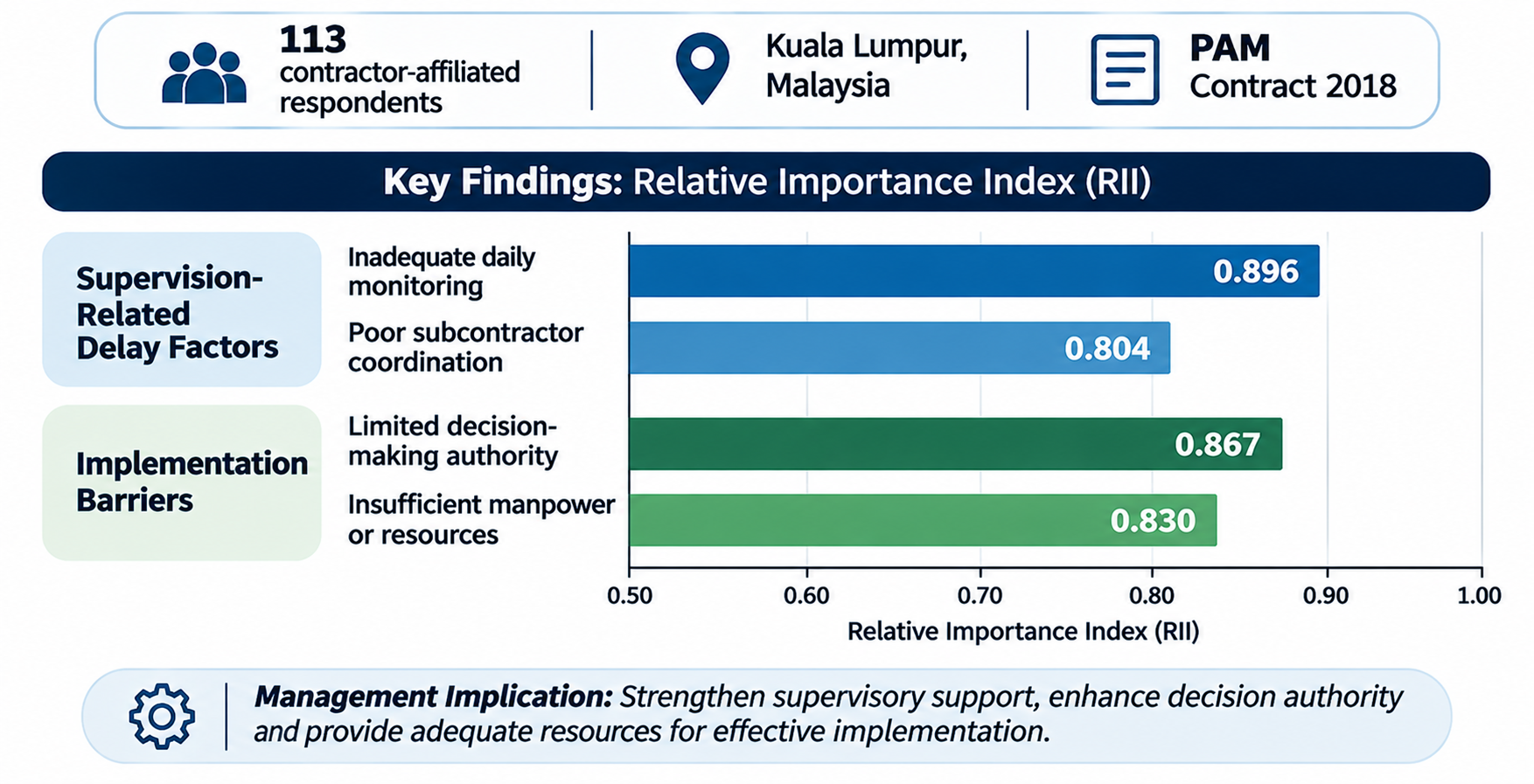
Effective contractor site supervision requires both professional competence and organizational support, yet these dimensions are often examined separately in construction-delay research. This study investigates perceived supervision-related delay factors, barriers to implementing supervisory responsibilities under Pertubuhan Akitek Malaysia (Malaysian Institute of Architects (PAM) Contract 2018, and management improvement priorities in Kuala Lumpur building projects. A quantitative, cross-sectional questionnaire survey yielded 113 contractor-affiliated responses through targeted, non-probability recruitment. Data were analyzed using descriptive statistics and the Relative Importance Index (RII). Inadequate daily monitoring ranked highest among supervisory delay factors (RII = 0.896), followed by poor subcontractor coordination (0.804). Limited decision-making authority (0.867) and insufficient manpower or resources (0.830) were the leading implementation barriers. Digital tools (0.858) and routine monitoring and reporting (0.851) received the highest improvement-strategy rankings. The findings suggest that supervisory development should combine task-specific training with clearer delegation, adequate resources and actionable reporting. The study contributes a management-oriented interpretation linking supervisory responsibilities with organizational implementation conditions. Non-probability recruitment, the predominance of quantity surveyors and reliance on perceptions limit generalizability and prevent causal conclusions.
References
Abioye, S. O., Oyedele, L. O., Akanbi, L., Ajayi, A., Delgado, J. M. D., Bilal, M., ... & Ahmed, A. (2021). Artificial intelligence in the construction industry: A review of present status, opportunities and future challenges. Journal of Building Engineering, 44, 103299. https://doi.org/10.1016/j.jobe.2021.103299.
Alaloul, W. S., Liew, M. S., Zawawi, N. A. W. A., & Kennedy, I. B. (2020). Industrial Revolution 4.0 in the construction industry: Challenges and opportunities for stakeholders. Ain Shams Engineering Journal, 11(1), 225–230. https://doi.org/10.1016/j.asej.2019.08.010.
Alfarsi, F. H. A., & Oo, Y. H. (2026). Organizational and project-management factors in capital-project delivery performance: A conceptual framework. International Journal of Management Thinking, 4(2), 16–37. oi.org/10.56868/ijmt.v4i2.118.
Galbraith, J. R. (1974). Organization design: An information processing view. Interfaces, 4(3), 28–36. https://doi.org/10.1287/inte.4.3.28
Halou, M. I. K., Samin, R., & Ahmad, M. (2019). Impacts of change management on risk and cost management of construction projects. Journal of Project Management, 4(2), 157–164. https://doi.org/10.5267/j.jpm.2019.1.005
Haloul, M. I. K., Mohd Ariffin, M. K. A., Supeni, E. E., Ahmad, S. A., Bilema, M., & Ahmad, M. (2024). A systematic review of the project management information systems in different types of construction projects. UCJC Business and Society Review, 21(80), 300–355. https://doi.org/10.3232/UBR.2024.V21.N1.08
Ijaola, I. A., Idoro, G. I., & Oladokun, M. G. (2023). Developing key indicators for site supervisors’ task performance in construction firms. International Journal of Construction Management, 23(2), 349–357. https://doi.org/10.1080/15623599.2020.1870057
Manoharan, K., Dissanayake, P., Pathirana, C., Deegahawature, D., & Silva, R. (2024). A systematic evaluation on the competencies of construction supervisors in productivity and performance improvement practices – Sri Lankan perspective. Smart and Sustainable Built Environment, 13(4), 960–988. https://doi.org/10.1108/SASBE-11-2022-0242.
Okhuysen, G. A., & Bechky, B. A. (2009). Coordination in organizations: An integrative perspective. Academy of Management Annals, 3(1), 463–502. https://doi.org/10.5465/19416520903047533
Pertubuhan Akitek Malaysia. (2018). Agreement and conditions of PAM Contract 2018 (With quantities). https://www.pam.org.my/images/notes/2019/1-PAM_Contract_2018_Roadshow_Slides_KL_23-02-2019.pdf
Sanni-Anibire, M. O., Mohamad Zin, R., & Olatunji, S. O. (2022). Causes of delay in the global construction industry: A meta-analytical review. International Journal of Construction Management, 22(8), 1395–1407. https://doi.org/10.1080/15623599.2020.1716132
Selcuk, O., Turkoglu, H., Polat, G., & Hajdu, M. (2024). An integrative literature review on the causes of delays in construction projects: Evidence from developing countries. International Journal of Construction Management, 24(6), 610–622. https://doi.org/10.1080/15623599.2022.2135939
Too, E. G., & Weaver, P. (2014). The management of project management: A conceptual framework for project governance. International Journal of Project Management, 32(8), 1382–1394. https://doi.org/10.1016/j.ijproman.2013.07.006
Tushman, M. L., & Nadler, D. A. (1978). Information processing as an integrating concept in organizational design. Academy of Management Review, 3(3), 613–624. https://doi.org/10.5465/amr.1978.4305791
Wang, Z., González, V. A., Mei, Q., & Lee, G. (2025). Sensor adoption in the construction industry: Barriers, opportunities, and strategies. Automation in Construction, 170, 105937. https://doi.org/10.1016/j.autcon.2024.105937
Yap, J. B. H., Goay, P. L., Woon, Y. B., & Skitmore, M. (2021). Revisiting critical delay factors for construction: Analysing projects in Malaysia. Alexandria Engineering Journal, 60(1), 1717–1729. https://doi.org/10.1016/j.aej.2020.11.021.
Yap, J. B. H., Skitmore, M., Chong, J. R., & Hon, C. K. H. (2022). Managerial measures to reduce rework and improve construction safety in a developing country: Malaysian case. Journal of Civil Engineering and Management, 28(8), 646–660. https://doi.org/10.3846/jcem.2022.17570
Downloads
Published
Issue
Section
License
Copyright (c) 2026 Wilgene Chung, Zetty Pakir Mastan, Kok Ching Wen, Nga Elsie, Samad Mohammad Ebrahimzade Sepasgozar

This work is licensed under a Creative Commons Attribution 4.0 International License.