Artificial Intelligence and Graduate Employability in Higher Education: A Systematic Review of Competency Development and Career Readiness (2013–2026)
DOI:
https://doi.org/10.56868/ijmt.v4i2.123Keywords:
Artificial intelligence, Graduate Employability, Competency Development;, Career Readiness, Higher EducationAbstract
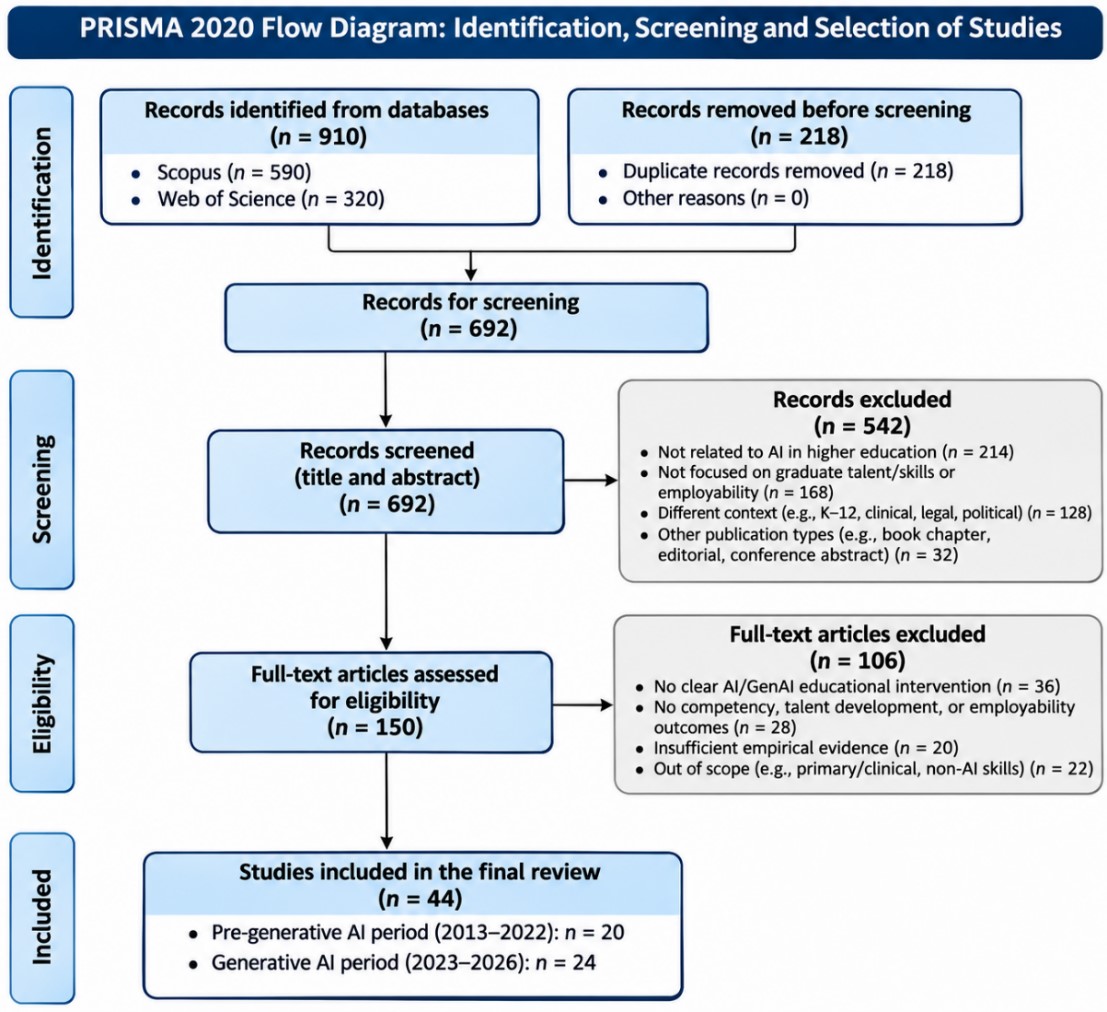
This comparative systematic literature review examines how artificial intelligence (AI) is used in higher education to develop graduate competencies and what evidence links these applications to career readiness and employability. This comparative systematic literature review examines research published between 2013 and 2026, drawing on Scopus and Web of Science. A narrative thematic synthesis compares the periods 2013–2022 and 2023–2026 across pedagogical approaches, competency outcomes, career readiness, and institutional conditions. The synthesis identifies an expansion from specialized instructional and analytical applications toward conversational assistance, generative feedback, and collaborative knowledge production. Reported benefits depend on pedagogical alignment, learner evaluation, self-regulation, and responsible oversight. AI literacy encompasses technical, evaluative, disciplinary, and ethical capabilities, while effective task allocation can preserve opportunities for independent reasoning. However, assisted performance, perceived employability, and actual employment outcomes remain distinct. The review clarifies potential pathways connecting AI-supported education with graduate preparation and identifies priorities for curriculum design, authentic assessment, and university–industry collaboration. Heterogeneous measures and limited longitudinal evidence constrain conclusions about sustained professional transfer and employment benefits.
References
Abhishek, N., Nayak, K. M., Divyashree, M. S., Dinesh, S., & Maradi, M. M. (2026). Integrating metaverse-enabled artificial intelligence and large language models in accounting education: An applied mixed-methods study. Asian Education and Development Studies, 1-34. https://doi.org/10.1108/AEDS-01-2026-0051
Al-Hussaini, S. H., Turi, J. A., Altamimi, A. N. A., Khan, M. A., & Ahmad, M. (2019). Impact of talent management strategies on employee performance behaviour with the mediating role of talent management outputs. Archives of Business Research, 7(3), 116–124.
Alalwani, S. (2026). Faculty perceptions of ChatGPT on academic integrity and institutional roles in higher education. Scientific Reports, 16, 27532. https://doi.org/10.1038/s41598-026-63852-x
Alam, M. M., Farhaz, S., Haq, S. M. A., & Ferdous, M. (2026). Generative artificial intelligence integration in higher education: A constructivist learning theory approach. Computers and Education Open, 10, 100378. https://doi.org/10.1016/j.caeo.2026.100378
Asad, M. M., & Anwar, K. (2025). Influence of artificial intelligence on students' career competencies and career resources: A global perspective. The International Journal of Information and Learning Technology, 42(4), 366–391. https://doi.org/10.1108/IJILT-05-2024-0091
Bal, M., & Arseven, T. (2026). Students’ writing skills and creativity in the age of artificial intelligence: A systematic review of creativity across diverse AI-supported writing contexts. Thinking Skills and Creativity, 60, 102118. https://doi.org/10.1016/j.tsc.2025.102118
Bilotta, E., Demarco, F., Soranzo, A., Pantano, P., & Bertacchini, F. (2026). A Pilot Educational Framework for AI-enhanced Digital Manufacturing and Reflective Skill Development. Computers and Education Open, 11, 100342. https://doi.org/10.1016/j.caeo.2026.100342
Bunea, Ș., Țuțui, D., Crețu, R. F., & Banța, V.-C. (2025). Sustainable accounting education through internship: Students' perception on the internship partners' role in competences development. The International Journal of Management Education, 23(3), 101276. https://doi.org/10.1016/j.ijme.2025.101276
Cantú-Ortiz, F. J., Galeano Sánchez, N., Garrido, L., Terashima-Marin, H., & Brena, R. F. (2020). An artificial intelligence educational strategy for the digital transformation. International Journal on Interactive Design and Manufacturing (IJIDeM), 14(4), 1195-1209. https://doi.org/10.1007/s12008-020-00702-8.
Chigbu, B. I., & Makapela, S. L. (2025). AI in education, sustainability, and the future of work: An integrative review of industry 5.0, education 5.0, and work 5.0. Journal of Open Innovation: Technology, Market, and Complexity, 11(4), 100645. https://doi.org/10.1016/j.joitmc.2025.100645
Christopoulos, A., Mystakidis, S., Perikos, I., Bourazeri, A., Michael, A., & Laakso, M.-J. (2026). How does collaborative prompting behaviour develop and relate to effectiveness in problem-solving with Generative Artificial Intelligence? Computers in Human Behavior: Artificial Humans, 9, 100378. https://doi.org/10.1016/j.chbah.2026.100378
Dabis, A., & Csáki, C. (2024). AI and ethics: Investigating the first policy responses of higher education institutions to the challenge of generative AI. Humanities and Social Sciences Communications, 11(1), 1006. https://doi.org/10.1057/s41599-024-03526-z
Dahri, N. A., Yahaya, N., & Al-Rahmi, W. M. (2025). Exploring the influence of ChatGPT on student academic success and career readiness. Education and Information Technologies, 30(7), 8877–8921. https://doi.org/10.1007/s10639-024-13148-2
Dasaklis, T. K., Giannopoulos, P. G., Koutras, D., Malamas, V., & Chountalas, P. T. (2026). Large language models in human resource management: A systematic literature review of applications, open issues and future research directions. Technological Forecasting and Social Change, 231, 124800. https://doi.org/10.1016/j.techfore.2026.124800
Dhamak, P., Pasi, B. N., & Kumar, A. (2026). Faculty readiness as the keystone: A DEMATEL-based strategic framework for AI-enabled competency-based engineering education in the Asia-Pacific. Asian Education and Development Studies, 1-27. https://doi.org/10.1108/AEDS-07-2025-0319
Du, C., & Qiao, S. (2026). Cultivating university students’ creativity and entrepreneurship: An AI-powered scenario-based design thinking approach. The International Journal of Management Education, 24(2), 101372. https://doi.org/10.1016/j.ijme.2026.101372
Elkhodr, M., & Gide, E. (2025). The SAGE framework for developing critical thinking and responsible generative AI use in cybersecurity education. Discover Education, 4(1), 517. https://doi.org/10.1007/s44217-025-00935-3
Eze, P., Lunn, S., & Berhane, B. (2026). Evaluating large language models for career guidance: A comparative analysis of computing competency recommendations across ten African countries. Computers and Education Open, 11, 100425. https://doi.org/10.1016/j.caeo.2026.100425
Ganuthula, V. R. R., & Balaraman, K. K. (2025). Artificial intelligence quotient framework for measuring human collaboration with artificial intelligence. Discover Artificial Intelligence, 5(1), 268. https://doi.org/10.1007/s44163-025-00516-1
Ghabban, M., Alsughayyir, Y., Alslimani, A., & Marzouq, A. (2026). The role of artificial intelligence tools in advancing business education based on technology acceptance and experiential learning framework. Discover Education, 5, 1013. https://doi.org/10.1007/s44217-026-01868-1
Gu, L., Gao, X., Li, R., Liu, Z., & Li, Y. (2026). Measuring AI literacy in design education: Development and validation of the artificial intelligence literacy scale for design students. International Journal of Technology and Design Education, 1-21. https://doi.org/10.1007/s10798-026-10128-0
Hendrawan, K., & Lestari, S. D. (2026). AI literacy and graduate employability in the age of artificial intelligence: The mediating role of career adaptability and the moderating role of growth mindset. Social Sciences & Humanities Open, 14, 103551. https://doi.org/10.1016/j.ssaho.2026.103551
Humble, N., & Mozelius, P. (2022). The threat, hype, and promise of artificial intelligence in education. Discover Artificial Intelligence, 2(1), 22.. https://doi.org/10.1007/s44163-022-00039-z
Jackson, L. A. (2025). Bridging the gap: Integrating hotel asset management and real estate finance in undergraduate hospitality education. Journal of Hospitality, Leisure, Sport & Tourism Education, 36, 100558. https://doi.org/10.1016/j.jhlste.2025.100558
Jaldemark, J., Lundin, J., Säljö, R., Edwards, J., Gegenfurtner, A., Holmes, W., Järvelä, S., de Laat, M., Lindberg, Y., Littlejohn, A., Seufert, S., Specht, M., Svensson, L., Rapanta, C., Hayes, S., & Zeivots, S. (2025). A multidisciplinary research agenda for artificial intelligence, education, learning, and instruction. Postdigital Science and Education, 7(4), 1414–1450. https://doi.org/10.1007/s42438-025-00602-8
Karataş, F., & Ataç, B. A. (2025). When TPACK meets artificial intelligence: Analyzing TPACK and AI-TPACK components through structural equation modelling. Education and Information Technologies, 30, 8979–9004. https://doi.org/10.1007/s10639-024-13164-2
Kim, S. (2026). Using verbal assessment to counteract AI-induced illusory competence: An innovation for clinical decision-making in perinatal nursing education. Teaching and Learning in Nursing, 21(3), e1238–e1242. https://doi.org/10.1016/j.teln.2026.02.013
Lai, C., Pan, M., Guo, K., & Cui, Y. (2026). What task to offload to GenAI in the writing feedback process? – Effects of task-offloading approaches on EFL learners’ writing skill development. Computers & Education, 252, 105675. https://doi.org/10.1016/j.compedu.2026.105675
Lau, G. R., Low, W. Y., Tay, L., Guevarra, Y. A., Gašević, D., & Hartanto, A. (2026). Understanding critical thinking in generative artificial intelligence use: Development, validation, and correlates of the critical thinking in AI use scale. Computers in Human Behavior Reports, 22, 101103. https://doi.org/10.1016/j.chbr.2026.101103
Li, L. (2024). Reskilling and upskilling the future-ready workforce for Industry 4.0 and beyond. Information Systems Frontiers, 26(5), 1697-1712. https://doi.org/10.1007/s10796-022-10308-y
Luo, Y., & Day, M. J. (2026). Determinants of lecturer readiness to adopt generative AI in higher education: Survey evidence from UTAUT and self-determination theory. Education and Information Technologies, 31(10), 3399–3430. https://doi.org/10.1007/s10639-026-13931-3
Magagula, M. M., & Awodiji, O. A. (2024). The implications of the fourth industrial revolution on technical and vocational education and training in South Africa. Social Sciences & Humanities Open, 10, 100896. https://doi.org/10.1016/j.ssaho.2024.100896
Martinez, N. C., Morini, S., & Jafari-Salim, B. (2025). Exploring nursing students' perspectives and experiences with artificial intelligence-driven patient interactions during a simulated placement: A qualitative study. Nurse Education in Practice, 87, 104500. https://doi.org/10.1016/j.nepr.2025.104500
Mhaske, P., Bhattacharjee, B., Haldar, N., Upadhyay, P., & Mandal, A. (2025). Bridging digital skill gaps in the global workforce: A synthesis and conceptual framework building. Research in Globalization, 11, 100311. https://doi.org/10.1016/j.resglo.2025.100311
Mohiuddin, K., Nasr, O. A., Miladi, M. N., Fatima, H., Shahwar, S., & Naveed, Q. N. (2023). Potentialities and priorities for higher educational development in Saudi Arabia for the next decade: Critical reflections of the vision 2030 framework. Heliyon, 9(5), e16368. https://doi.org/10.1016/j.heliyon.2023.e16368
Mustafa, S. A., & Altrad, A. (2026). Artificial intelligence adoption future ready skills and graduate employability in higher education. Scientific Reports, 16, 34398. https://doi.org/10.1038/s41598-026-64272-7
Nathaniel, J., Oyelere, S. S., Suhonen, J., & Tedre, M. (2025). Literature review on the integration of generative AI in programming education. International Journal of Artificial Intelligence in Education, 35(5), 2724–2755. https://doi.org/10.1007/s40593-025-00524-3
Nguyen, T. P. (2026). Graduate skill gaps in applied higher education: A triadic analysis from a work-based learning perspective. Higher Education, Skills and Work-based Learning, 16(3), 677–692. https://doi.org/10.1108/HESWBL-01-2026-0063
Pandey, S., & Dash, M. K. (2026). Building competent IT freshers: Modelling digital era training frameworks. European Journal of Training and Development, 50(5–6), 520–546. https://doi.org/10.1108/EJTD-10-2025-0242
Popenici, S. A. D., & Kerr, S. (2017). Exploring the impact of artificial intelligence on teaching and learning in higher education. Research and Practice in Technology Enhanced Learning, 12(1), 22. https://doi.org/10.1186/s41039-017-0062-8
Qomariyah, N. N., & Heriyanni, E. (2026). Ethical readiness and behavioral intention toward generative AI: Student perspectives from STEM and non-STEM disciplines in Indonesian higher education. Journal of Information, Communication and Ethics in Society, 1-25. Advance online publication. https://doi.org/10.1108/JICES-05-2025-0100
Ren, Y., & Khan, S. U. (2026). Generative AI in music learning: A mixed-method study of skill development, AI dependence, and the moderating role of AI literacy. Acta Psychologica, 270, 107648. https://doi.org/10.1016/j.actpsy.2026.107648
Rodger, D., Mann, S. P., Earp, B., Savulescu, J., Bobier, C., & Blackshaw, B. P. (2025). Generative AI in healthcare education: How AI literacy gaps could compromise learning and patient safety. Nurse Education in Practice, 87, 104461. https://doi.org/10.1016/j.nepr.2025.104461
Rodríguez-Montoya, C., Garrido, L. E., & van der Linde, G. (2026). Artificial intelligence integration in higher education: A global systematic thematic synthesis of opportunities, risks, and emerging frontiers. Discover Education, 5(1), 953. https://doi.org/10.1007/s44217-026-02175-5
Santana, M., & Díaz-Fernández, M. (2023). Competencies for the artificial intelligence age: Visualisation of the state of the art and future perspectives. Review of Managerial Science, 17(6), 1971-2004. https://doi.org/10.1007/s11846-022-00613-w
Schiff, D. (2021). Out of the laboratory and into the classroom: The future of artificial intelligence in education. AI & Society, 36(1), 331-348. https://doi.org/10.1007/s00146-020-01033-8
Setiawan, G., Jacob, G. S., & Yoenanto, N. H. (2026). Need satisfaction and need frustration in generative artificial intelligence use among higher education students: A scoping review. Learning and Motivation, 96, 102358. https://doi.org/10.1016/j.lmot.2026.102358
Shi, Y., Yu, K., Dong, Y., & Chen, F. (2025). Large language models in education: A systematic review of empirical applications, benefits, and challenges. Computers and Education: Artificial Intelligence, 10, 100529. https://doi.org/10.1016/j.caeai.2025.100529
Shomotova, A., ElSayary, A., & Husain, S. (2026). What shapes students’ AI literacy? Investigating digital competence, student background, and GenAI use in higher education. Education and Information Technologies, 31(2), 387–418. https://doi.org/10.1007/s10639-025-13832-x
Singh, U., Tewari, V., & Das, S. (2025). Digital workforce competencies: A multidimensional scale for the 21st century. Acta Psychologica, 261, 105883. https://doi.org/10.1016/j.actpsy.2025.105883
Symes, C., Query, B., Kennedy, D., Maksymiw, A., & Flegel, S. (2026). Experiences of Canadian nursing students using generative artificial intelligence: A scoping review. Teaching and Learning in Nursing, 21(3), e1401–e1407. https://doi.org/10.1016/j.teln.2026.03.023
Tilwani, S. A., Assefa, Y., Alhur, A. A., Spahiu, I., Moges, B. T., Ejupi, S., & Majeed, H. (2026). Harnessing generative artificial intelligence for personalized learning and transformative skill development in higher education in developing-country contexts. Discover Artificial Intelligence. https://doi.org/10.1007/s44163-026-01300-5
Wider, W., Wong, C. T., Wong, Y. F., Nor, N. M., Fauzi, M. A., Tanucan, J. C. M., & Sawitri, D. R. (2025). Employment trends among postgraduate students: A bibliometric analysis. Asian Education and Development Studies, 14(5), 1126–1154. https://doi.org/10.1108/AEDS-10-2024-0245
Wu, Q., Chen, L., Chen, M., & Huang, Y. (2026). Exploring the impact of artificial intelligence on business talent development in higher education: A systematic literature review and research agenda. The International Journal of Management Education, 24(1), 101287. https://doi.org/10.1016/j.ijme.2025.101287
Xia, Q., Liu, Q., Tlili, A., & Chiu, T. K. F. (2026). A systematic literature review on designing self-regulated learning using generative artificial intelligence and its future research directions. Computers & Education, 240, 105465. https://doi.org/10.1016/j.compedu.2025.105465
Yan, B. H., & Wang, P. G. (2026). Negotiating the threshold: A reflexive thematic analysis of undergraduate nursing students' experiences of generative artificial intelligence in learning. Teaching and Learning in Nursing. https://doi.org/10.1016/j.teln.2026.10.012
Yaya, R., Jalaludin, D., Widiastuti, H., & Ngooi, K. J. (2025). Accounting competencies, digital intelligence and work readiness of accounting undergraduates: A comparative analysis between Malaysia and Indonesia. Higher Education, Skills and Work-based Learning, 15(5), 1004–1023. https://doi.org/10.1108/HESWBL-08-2024-0223
Ying, J. (2026). Academic integrity in the age of generative AI: A scoping review of research on higher education student voices. Journal of Academic Ethics, 24(3), 78. https://doi.org/10.1007/s10805-026-09752-1
Zhou, C. (2023). Integration of modern technologies in higher education on the example of artificial intelligence use. Education and Information Technologies, 28(4), 3893-3910. https://doi.org/10.1007/s10639-022-11309-9
Downloads
Published
Issue
Section
License
Copyright (c) 2025 Liya Ma, Izazol binti Idris

This work is licensed under a Creative Commons Attribution 4.0 International License.